
What is in this product? Where do the materials come from? How can it be repaired or recycled?
These questions are becoming increasingly relevant, and often prove difficult to answer. Companies often do have the information, but scattered across technical sheets, supplier contracts, Excel files and folders on a shared drive. Consumers, recyclers and regulators do not have access to it.
The European Commission solves that with the Digital Product Passport (DPP): a mandatory digital file that bundles all relevant product information and makes it accessible via a single scan. For your organization, this is both a new obligation and an opportunity to better understand your products and supply chain.
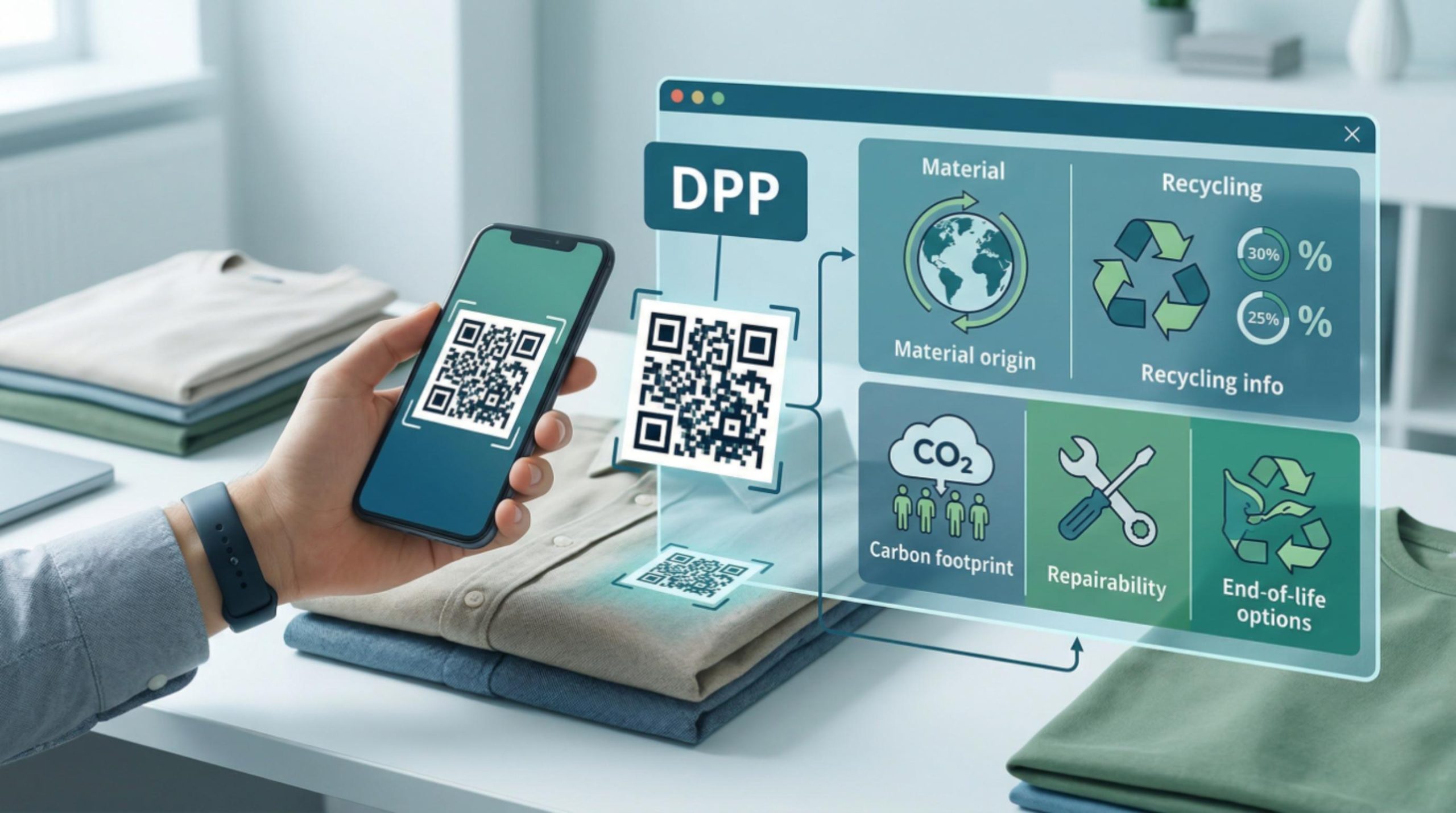
What exactly is a Digital Product Passport?
A DPP is a structured, digital data set associated with a specific product. Think of it as a digital identity card that follows the product through its entire life cycle, from production to recycling. The idea is simple: all relevant information about a product in one place, digitally accessible to those who need it.
There will be a data carrier on every product: a QR code, NFC chip or RFID tag. Scan that code and you get to the digital passport via a unique URL. In it you will find information about:
- Material composition and origin – what raw materials and where they come from
- Production – locations, processes, energy consumption
- Environmental footprint – carbon emissions, water consumption, resource use
- Repair and maintenance – instructions, available spare parts, expected service life
- Disassembly and recycling – how to take apart, what materials are recoverable
- Hazardous substances – SVHCs under REACH, substances of concern
- Certificates – CE marking, declarations of conformity, test results
The DPP is not a static document that you fill out once and then forget about. It is updated over the life of the product: after repairs, upgrades or ownership transfers. This repair information ties in directly with the right to repair, which since July 2026 has required manufacturers to repair commonly used products even outside the warranty period. A battery passport, for example, contains dynamic data on the State of Health, which changes as the battery is used.
Not everyone sees the same information. This is a common concern among companies we talk to: “So should our entire supply chain become public?” The short answer is no. The ESPR will work with access levels by type of user. After all, not all data is public, and sensitive data can be protected that way.
Only market surveillance authorities will have access to the full dataset. This is a deliberate choice in the ESPR: a balance between transparency and protection of business-sensitive information.
The ESPR: why the DPP is coming.
The Digital Product Passport is part of the ESPR: the Ecodesign for Sustainable Products Regulation (EU 2024/1781). This regulation came into force on July 18, 2024 as a successor to the 2009 Ecodesign Directive, which focused mainly on the energy consumption of appliances such as washing machines and refrigerators.
The ESPR goes much further. Where the old directive, for example, required a washing machine to be more energy efficient, the ESPR looks at the full life cycle: what materials are in it, how long does the product last, can it be repaired, and what happens at the end of its life? Ultimately, almost all physical products on the EU market are covered, with the exception of food and pharmaceuticals.
The seven pillars of the ESPR:
- Ecodesign requirements – minimum requirements for durability, repairability and recyclability
- Digital Product Passport – mandatory digital file containing all relevant product information
- Information requirements on substances of concern
- Destruction ban – unsold consumer goods may no longer be destroyed (applies to textiles and footwear as of July 2026 for large enterprises)
- Sustainable procurement – stricter criteria for government buyers in tenders
- Control: strengthened market surveillance and enforcement
- New requirements for sustainability information and labels
Important: The ESPR is a regulation, not a directive. It applies directly in all EU member states, without national transposition. The specific requirements for each product group will be laid down in delegated acts[i], which the European Commission will roll out incrementally over the next few years.
When will the DPP become mandatory?
The ESPR entered into force on July 18, 2024, but it is being phased in, product group by product group. The Working Plan (COM (2025) 187, published in April 2025) lays out which categories will come first.
A crucial point that is often overlooked: a DPP becomes mandatory only after the delegated act for that product group has been published AND the transition period of at least 18 months has passed. The years you come across in the public debate are often the expected date of the delegated act, not the date you actually have to be compliant. Below is the state of affairs as of March 2026:
| Product category | Expected adoption delegated act | Expected DPP obligation | Status |
| Batteries | N/A (separate track) | February 2027 | Final (EU 2023/1542) |
| Iron & Steel | 2026 | ~2028 | Delegated act in preparation |
| ICT & Electronics | 2026 – 2027 | 2028-2029 | High priority |
| Textiles & Clothing | 2027 | ~2029 | High priority |
| Tires | 2027 | ~2029 | High priority |
| Furniture | 2028 | ~2030 | Second priority group |
| Aluminum | 2028 | ~2030 | Second priority group |
| Construction Products | Phased by product family | ~2028-2029 (first families) | Final (EU 2024/3110) |
| Mattresses | 2029 | ~2031 | Third priority group |
The battery regulation (EU 2023/1542) is leading the way and is proof that the DPP is no longer an abstract future story. From Feb. 18, 2027, all industrial batteries above 2 kWh, EV batteries and LMT batteries must have a battery passport. The technical specifications will be defined in delegated acts that are currently being finalized. Construction products are another example and are covered by revised Construction Products Regulation (EU 2024/3110), which became applicable on Jan. 8, 2026
For the other categories, the situation is less definitive. The delegated act for textiles was initially foreseen in early 2026, but as of March 2026 it has not yet been published. Recent signals from the Commission point to publication in 2027, pushing the actual DPP obligation for textiles toward 2028-2029.
What should be in a DPP?
This is the question we get most often, and the answer is more complex than it first appears. The ESPR defines a set of basic data points that apply to all product categories; you could divide these into a number of themes such as:
- Product identification – unique product ID, data carrier, GTIN, commodity code
- Economic operators – manufacturer, importer, contact details, EORI number
- Conformity – CE declaration, technical documentation, user manual
- Sustainability & circularity on life-cyclematerial composition, carbon footprint, recycled content, repairability, hazardous materials, disassembly instructions
- System requirements – hosting, availability, access rights, interoperability
Those are the basic fields. On top of that there are additional data points for each product category, and that’s where the difference between categories lies. For batteries, think of data points such as State of Health and due diligence on critical raw materials, and for Building Products, think of fire classification, thermal performance and Environmental Product Declarations.
In our experience, the sustainability & circularity block is where most companies have the biggest gaps. Not because the information doesn’t exist, but because it’s scattered across departments that rarely talk to each other. Manufacturing knows what materials go into it. R&D knows how repairable it is. Sustainability has the LCA data. But no one has the big picture. In our article on what data a DPP should contain, we explain all the fields by category.
Keeping up with new sustainability legislation?
EmpCo, CSRD, PPWR, DPP: the rules change fast. In our newsletter we explain what changes, what it means for your organisation and which free tools you can use to check it yourself. A few times a year at most.
Free. Unsubscribe any time.
Benefits of the Digital Product Passport
At Empact, we see the DPP as a catalyst that forces companies to really understand their products. That may sound abstract, but the companies we assist notice it already in the preparation phase. Bringing product data together provides insights that go beyond compliance.
For producers and manufacturers:
The most immediate benefit is competitive advantage. Buyers from large retailers and OEMs are increasingly asking for product passport data, even if it is not yet required by law. Those who can provide a DPP early win tenders and build customer trust.
In addition, the DPP replaces vague sustainability promises with verifiable data. This is relevant now that the Empowering Consumers for the Green Transition Directive (effective September 2026) sets stricter requirements for environmental claims. A DPP is proof that your claims are substantiated.
Building a DPP also forces you to map out your supply chain. In doing so, companies we assist regularly discover inefficiencies and risks they were unaware of. And the data you collect isn’t just useful for your DPP: the same information can be used for CSRD reporting, supplier assessments and product optimization. One investment, multiple uses.
For consumers, the DPP allows them to compare products for durability, longevity and repairability. They know where a product comes from, what’s in it, and how to get it repaired.
For recyclers and waste handlers, the DPP is perhaps most valuable. Instead of guesswork, they get exact material data and disassembly instructions. That leads to more efficient material separation and higher recycling rates.
Preparing for the DPP in 5 steps
Implementing a DPP requires a thoughtful approach. But it does not have to become a monster project. In the companies we assist, we always see the same pattern: those who start step by step and make smart use of existing data are ready sooner than expected.
Step 1: Bring your stakeholders together
A DPP touches multiple departments: production, quality, procurement, R&D, IT and legal. That makes it tempting to position it as an IT or compliance project, but that’s a trap. The DPP is a data project that needs an owner who can shift gears right across the organization. Designate that owner, make sure all departments involved understand what’s coming, and make clear agreements about who provides and manages what data.
Step 2: Inventory your existing data
This is where it falls down for most companies. Technical data sheets, MSDS documents, EPDs, CE declarations, supplier data: much of this information is directly relevant to your DPP. At the companies we assist, an initial inventory usually reveals that 40 to 60 percent of the required data is already present. The problem is not that the data is not there, but that no one has put it together.
Our free Empact DPP Tool does that for you: upload your existing documents and find out within five minutes which DPP data points you can already complete, and which ones you can’t. A practical step-by-step plan can be found in this article: DPP data collection: how to do it.
Step 3: Complete missing data
The DPP Tool automatically generates a gap analysis. What you miss usually falls into three categories: data that is available internally but not yet structured, data that must come from suppliers (think upstream carbon footprint and material origin), and data that must be calculated externally, such as an LCA for your carbon footprint. The latter category is often the most time-consuming, but the investment is not only useful for your DPP: you can use the same LCA data for your CSRD reporting and product communications.
Step 4: Involve your supply chain
A DPP is not a solo project. Material sourcing, upstream CO₂, certificates of raw materials: that has to come from your suppliers. Experience shows that most suppliers want to cooperate, provided you clearly communicate what you need and why. A concrete request with specific data points yields better results than a vague “we need DPP data.” Include DPP data requirements in your purchasing requirements and start with your tier 1 suppliers. You can read more about supply chain responsibilities and how to approach this in the article on the DPP and your supply chain.
Step 5: Choose a platform and monitor
Once your data is complete, you need a platform that meets EU standards for interoperability with the DPP registry. The standards for this are still under development (CEN/CENELEC is working on harmonized standards, expected by the end of 2026). Therefore, work with open standards and flexible APIs so that your system remains adaptable when the final standards are established.
A DPP is not a one-time project. It evolves with your product. Establish processes to update the passport after product changes, repairs or new insights.
Frequently asked questions about the DPP
Is the DPP already mandatory?
Not yet for most products. The first obligation is for batteries (February 2027). Other product categories will follow between 2028 and 2030, depending on when the delegated acts are published. But the ESPR basic fields will soon apply to everyone. Those who start taking inventory now won’t soon have to sort everything out at once.
Does the DPP also apply to SMEs?
Yes. The ESPR does not differentiate by company size. If you put a product on the EU market that is covered by a delegated act, you need a DPP, regardless of whether you have five or five hundred employees. Especially for smaller companies, it pays to start early because you have less capacity to deal with it last-minute. The ESPR does contain provisions to limit the burden on SMEs, but it is not an exemption.
What does a DPP cost?
This varies widely and depends mostly on how well your current documentation is in order. The biggest cost is the collection and structuring of data, not the platform. A company that already keeps its technical data sheets, SDS’s and supplier data up to date will be ready faster than one that still has to build everything.
As an importer, should I also have a DPP?
Yes, and in practice, you as an importer often bear full responsibility if your non-EU manufacturer does not pick it up. You have to verify that a correct DPP has been created and add your own data (name, address, EORI number). Therefore, include DPP requirements in your supplier selection and procurement contracts now. The later you address this, the harder it becomes.
Can I reuse existing data?
Absolutely. CE declarations, EPDs, technical data sheets, REACH documentation: many existing documents contain useful DPP data. The trick is to structure them according to DPP standards. “In a PDF on the shared drive” is not the same as “structured, machine-readable and interoperable.”
How does the DPP relate to the CSRD?
The DPP is about product and the product’s ESG information. The CSRD is about the organization and the ESG information about the organization. The data used is fundamentally different. Also, some of the people involved within an organization will work in different departments.
Getting Started
The DPP is not an administrative endpoint. It is a tool that forces companies to better understand their products and chains. And those who understand their products better make better decisions: for compliance, for business and for the planet.
The companies we talk to often wonder if they are “too early.” Our answer is always the same: You are not too early if the basic fields are already established, your suppliers need time to provide data, and your competitors are already working on it. The question is not whether the DPP is coming, but whether you will be ready when it does.
Want to know where you stand?
Upload your existing product documentation to the free DPP Tool. You instantly see which DPP information you already have and what is still missing, and you get a gap analysis with an example DPP. No account needed, documents are not stored.
Start the free DPP analysisReady for the next step? Get in touch with Empact. With our DPP consulting, we help you go from insight to implementation.
[i] Delegated acts are legally binding decisions of the European Commission that are used to supplement or amend non-essential elements of EU legislation, such as updating technical details or detailed rules.