
Almost every company packs something. A box, a film, a bottle or a bag to get your product safely to the customer. Exactly that everyday part of your business will change dramatically in the coming years. In 2023, the EU produced 79.7 million tons of packaging waste, or 177.8 kilograms per inhabitant. That mountain has to come down, and the PPWR is the key tool for that. The PPWR, in full the Packaging and Packaging Waste Regulation, sets new requirements for just about all packaging entering the European market. And contrary to what many companies think, this doesn’t just affect large manufacturers. If you import products, run a web shop or market packaged goods, you have to deal with it.
In this article, we briefly outline what the PPWR is, who it applies to, what will change and how to prepare.

What is the PPWR?
The PPWR is the new European packaging regulation, officially Regulation (EU) 2025/40. It replaces the old 1994 packaging directive (Directive 94/62/EC), and that difference is more important than it sounds. A directive must first be translated by each country into its own legislation, so the rules differ from one member state to another. A regulation works directly and the same everywhere in the EU, without national transposition. Whether you sell in the Netherlands, Germany or Spain, the same requirements apply. The general application date is Aug. 12, 2026.
The goal is clear. Less packaging waste, packaging that is actually recyclable, more recycled material in it, fewer substances of concern and more reuse. Together, these should reduce the growing mountain of packaging waste in Europe and accelerate the transition to a circular economy. In this, the PPWR does not stand alone. It is part of a broader wave of European sustainability legislation, alongside, for example, the ESPR the CSDD.
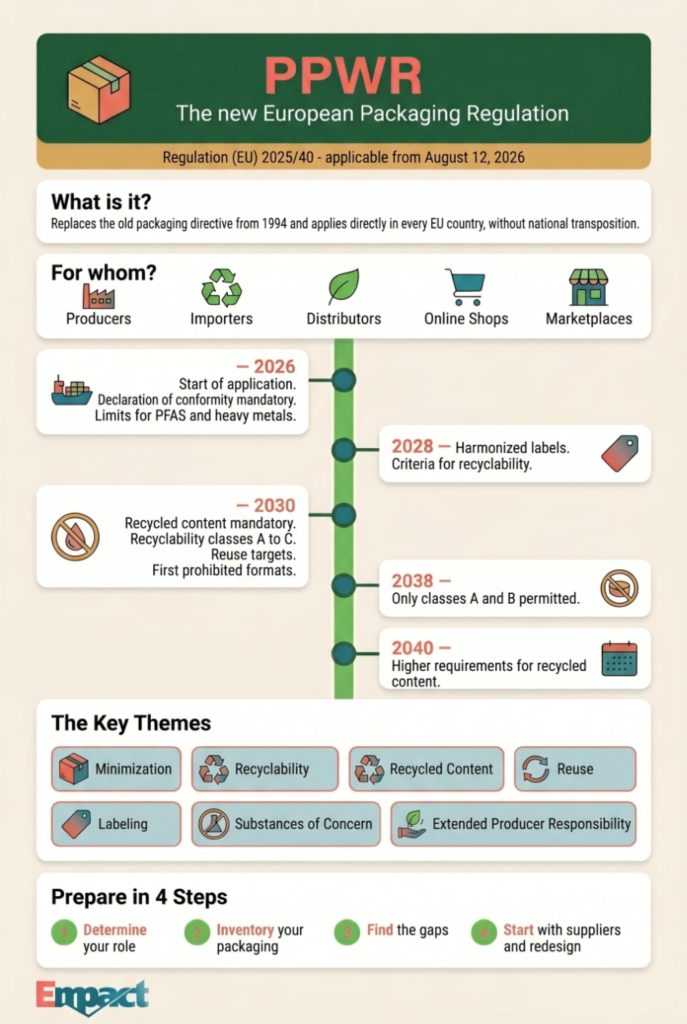
Who does this EU regulation apply to?
In short, for anyone who puts packaging on the European market. That’s a broad group. It includes manufacturers, importers, distributors, fulfillment companies and online marketplaces. The special thing is that your role determines exactly what you need to do. The same box may primarily mean a reporting obligation for one party and a task to redesign for another.
Many companies misjudge their role. Importers sometimes assume that the foreign manufacturer is responsible, while in the EU they are the first to market the packaging. Webshops often underestimate their position. And the thought “we are too small, this does not apply to us” is rarely true, because there is no general exemption based on company size. Defining your role is therefore the first and most important step.
The ten themes in brief
The PPWR is broad. To keep a grip, it helps to divide the regulation into 10 themes. Below are them, with what they mean and when you must become compliant in one sentence. Keep in mind that the dates have been kept rough; some requirements are still being filled in through additional European regulations, called delegated acts.
| Theme | What it entails | From when |
| Compliance and governance | You demonstrate that your packaging complies with technical documentation and a declaration of conformity. | 2026, ascending |
| Substances of concern | Heavy metals (lead, cadmium, mercury and chromium VI) combined may not exceed 100 mg/kg in any packaging, and substances such as PFAS in packaging that touches food are subject to strict limits. | 2026 |
| Labeling and identification | Harmonized labels by material type and on waste bins, plus marking of reusable packaging. | 2028 |
| Recyclability | Packaging must be designed for recycling and achieve a minimum recyclability rating to be allowed on the market. | 2030, more stringent in 2038 |
| Recycled material | Plastic packaging must contain a minimum percentage of recycled material. | 2030, higher in 2040 |
| Reuse | Reusability goals apply to certain transportation and group packaging. | 2030, increasing |
| Minimization | Packaging should not be larger or heavier than necessary, and empty space in boxes is capped. | 2030 |
| Prohibitions and restrictions | Certain single-use plastic formats are banned. | 2030 |
| Compostability | Some specific items must be compostable. | yet to be determined |
| Producer responsibility | Producers register and file returns; in the Netherlands this is done through Verpact. | already running, changes |
The dates in a nutshell
The headline above the news is Aug. 12, 2026, the time when the PPWR will apply and the first obligations take effect. But the real work lies further down the timeline. Around 2028 comes the harmonized labeling system and the recyclability criteria. The center of gravity will be in 2030: then the requirements for recycled material, recyclability classes, reuse targets and the first banned formats will go into effect. Packaging will soon be classified from A to E; from 2030, only class A to C will be allowed on the market, and from 2038 only A and B. After that, the bar goes up further toward 2035 and 2040.
Note that there is no general transition period. Packaging that does not comply may not be placed on the market after Aug. 12, 2026. Stock that is already in the chain may often still be sold, but the rules for this vary by state.
It is tempting to see 2030 as far away. Yet that is a misconception. Redesigning packaging and getting your suppliers on board quickly takes one to two years. So for those who don’t know now which packaging will soon be inadequate, 2030 is closer than it seems.
Keeping up with new sustainability legislation?
EmpCo, CSRD, PPWR, DPP: the rules change fast. In our newsletter we explain what changes, what it means for your organisation and which free tools you can use to check it yourself. A few times a year at most.
Free. Unsubscribe any time.
Will the date still be postponed?
Parts of the industry have recently called for a postponement of the application date, arguing that some of the technical details have not yet been fully worked out. However, the European Commission is sticking to Aug. 12, 2026, and on March 30, 2026, published a final guidance document with an extensive list of questions and answers designed to ensure the regulation is interpreted in the same way across the EU. The message is thus clear: don’t count on delay and start preparing.
What will you have to demonstrate later?
Complying is one thing, demonstrating that you comply is another. Under the PPWR, you must be able to substantiate your compliance with technical documentation and a declaration of compliance. That’s exactly the part many companies don’t have ready. The European Commission can request that documentation and expects you to provide it within ten days, so loose evidence scattered throughout the chain is not enough.
It pays to get that documentation in order early. In the Netherlands, the Dutch Food and Consumer Product Safety Authority and the Environment and Transport Inspectorate (Inspectie Leefomgeving en Transport) are among the supervisory authorities, and violations can result in fines. Moreover, without proof it is difficult to prove that your packaging meets the requirements, whether you are dealing with a supervisor, a customer or a financier.
Digital labels and QR codes
The PPWR is also making packaging digital. Starting in 2028, in addition to the harmonized label, there will be a QR code or similar data carrier on packaging that links to information about the material, recycled content, any substances of concern and how to dispose of the packaging. Do not confuse this with the digital product passport (DPP). That is a separate requirement from the Ecodesign Regulation and deals with products, not packaging. The two are often used interchangeably in practice, and the PPWR leans on that same Ecodesign framework for the definition of substances of concern, but they remain different systems.
Preparing in four steps
- Define your role. Are you a manufacturer, importer, distributor or something else? Your role determines all your further commitments, so this is the logical first step.
- Inventory your packaging. Map out what packaging you use, what material it is made of and in what volumes you market it.
- Find the holes. Put your packaging next to the requirements and see where you are not currently complying, especially on recycled material, recyclability and prohibited sizes.
- Start suppliers and redesign on time. This is the step with the longest lead time. Waiting until just before a deadline is not an option.
Frequently Asked Questions
Does the PPWR also apply to my webshop packaging?
Yes. Packaging for online sales is expressly covered by the regulation, including rules on the amount of empty space in the box.
Does it also apply to SMEs?
Yes, largely. There is no general exemption based on company size; your role determines what requirements apply. The very smallest companies get lighter rules for some obligations, for example that the technical documentation is with their EU supplier, but they too are not exempt from producer responsibility. So count on it to apply to you as well. For SMEs, we have separate sustainability support.
As an importer, do I have to do anything?
Yes. If you bring products into the market from outside the EU, then you are often the first to introduce packaging in Europe, with the corresponding obligations.
What happens if I don’t comply?
You may not market packaging that does not meet the requirements. Regulators can request your documentation and impose fines. The exact national sanctioning will be determined in additional legislation in the Netherlands.
Does the PPWR replace the Dutch rules?
The PPWR works directly across the EU. National implementation, such as producer responsibility through Verpact, will remain in place and will be adapted to the new regulation.
Where do you start?
The PPWR is comprehensive, and exactly what it means for you depends a lot on your role and your packaging. Want to know quickly where you stand? With Empact’s free PPWR tool you can determine your role and list your tasks based on your situation. A nice first step to get an overview. And when it comes down to it, we like to think along with you to get real value out of it. Want to spar about your situation? See how our PPWR consulting works or feel free to contact us.
Determine your role and tasks under the PPWR
The free PPWR tool guides you step by step from your role and the EPR check to a personalized task overview with deadlines. You don’t need to know anything about the PPWR beforehand. No account needed.
Start the free PPWR tool